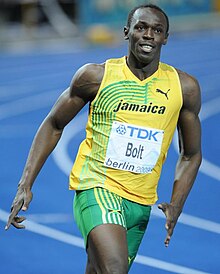
I recently met a few of my fellow Jamaican Olympic athletes, and I must admit I was immediately awestruck by their magnificent physique. It's not that you don’t expect a well-defined, chiseled body—after all, they do work extremely hard at it--but at close range you immediately separate them from us, based simply on their spectacularly lean muscle mass and high level of fitness.
They are, after all track and field stars and they look it. The likes of Bolt, Powell, Foster-Hylton, and Campbell-Brown, are just a few Jamaican athletes with international star power, whose surnames alone sufficiently identifies them. What inspires me most about these athletes is the way they maintain their state of physical and mental conditioning. The discipline and effort involved in honing their talent, staying in shape on-and-off season, and performing at the peak of their game when needed encouraged me to do my own research on their training techniques.
If the results of my regular 30 minute workout could produce the lean contours exhibited in some of these athletes, I would have outdone myself. It made me wonder about persons of average fitness, how long they'd need to “sweat it” in the gym to gain the lean muscles of an athlete?
Guess what, not as long as you'd think! You can get some amazing results with 30 minutes a day of high intensity workout mixed into your regular fitness program. Surprisingly, it doesn't require endless hours at the gym, but you must be willing to commit to a regimen and work feverishly-hard during a 30 minute session.
Lesson #1: Athletes Are Natural Competitors
The first lesson is to have a burning desire to achieve your fitness target and then go for it until you see the results. Athletes are naturally talented and they all possess one admirable distinction from many of us, a highly competitive nature. They have an innate fire to be the best, a spirited vigor that fuels their appetite to go after gold, and that’s the stuff that creates top athletes in the world.
Brigitte Foster-Hylton made history for women after the age of 30. At the brink of retirement, Foster-Hylton was suddenly heralded to the top. She was the oldest athlete at 34 years to win Olympic gold in Berlin, 2009.
The fastest man on the planet, Bolt, along with several other world-ranking athletes will tell you stories about overcoming obstacles (injuries, demotivated spirit) using inner strength and resilience to be where they are today.
Creating a body like an Olympic athlete requires you to build upon elements of fortitude as the foundation for success. Finding creative ways to motivate yourself will keep you focused and will create the difference between mediocrity and extraordinary achievements. You do get what you put in!
Lesson #2: Mix Your Workout with High Intensity Interval Training (HIIT)
Track athletes train according to their area of specialty. Short distance runners, for example, have to complete sprinting exercises in seconds at maximum effort to achieve fast twitch muscle fibers for high energy and endurance. A sprinter’s ability to transfer power from the feet to the rest of the body requires targeted training. High intensity interval training (HIIT) is the conditioning exercise of choice for coaches.
If you want to look like a sprinter you would have to train like one. HIIT allows you to burn more calories in the least amount of time while targeting specific muscle groups. Areas such as hip flexors, hamstring, quads and core will promote speed, agility and quickness on the track.
This type of work out is not easy and is geared towards persons who have already attained intermediate to advanced levels of fitness. If you are a fan of P90X, the popular exercise program that uses the term “muscle confusion” as part of its marketing slogan, then you have a basic idea of what is involved in HIIT. Your workout is short because at the end of it you are left utterly depleted of energy.
It is not strange for some athletes to get sick and gag during a session, mostly due to the high level of stress placed on the gastrointestinal (GI) system. Training examples may include sprinting/swimming/jumping rope drills at 100% effort with little rest time, along with high-knee skips, bunny hops, and frog leaps to build explosive strength and stamina.
High intensity training produces Excess Post-exercise Oxygen Consumption (EPOC), which essentially means it will rapidly increase your metabolism in just 1 session of maximum effort, allowing your metabolism to remain elevated for up to 36 hours. It is a great addition to a regular strength training program and can be incorporated at least 3 times per week for 30 minutes.
Lesson #3 Nutrition and Energy Boosters
Nutrition and exercise are inextricably linked. You cannot have one without the other and many world class athletes depend on the guidelines of a dietician to help maximize calorie intake to achieve optimum energy output to complete a workout.
To power a track athlete through to a 100 to 200 meter race requires high carbohydrate intake and sufficient glycogen stores. Explosive muscle contractions during a race are fueled with carbohydrates to meet the demands of intense movements. Protein and fat, though equally important, are not as rapidly oxidized as filling up on dietary carbohydrates.
Regardless, the majority of an athlete’s food intake still comes from protein with the right balance distributed as 60% protein, 30% carbs, and 10% fat. Sprinters need a minimum of 1 gram of protein per pound of bodyweight to build and maintain muscles.
Supplements are recommended though not considered essential. Creatine and glutamine mixes provide a well- deserved boost for pre-and-post HIIT workouts. Creatine helps replenish energy stores lost during high intensity training, while glutamine, a type of amino acid, supports the immune system, builds muscles, and boost fast recovery after a maximum workout.
Olympian Bolt, nicknamed “lightning bolt” is one of a few athletes who does not take supplements, but admits to occasional intake of vitamin C.
Lesson #4 Learn the Principles of Sports Neurology
A new type of training called sports neurology fixates on the role of the central nervous system (CNS) in achieving maximum adaptation to a strenuous workout schedule. It uses a cognitive level of training to condition the mind and body to prevent early fatigue. Improving mental focus is one of the critical components to this scientific based training. The program includes high tech applications of cold light laser to activate parts of the brain for improved performance.
The cerebellum and diencephalon are 2 very important areas of the brain in CNS training. When stimulated they allow an athlete to execute outstanding feats as the brain efficiently synchronizes to intense demands placed on the whole body.
Will power and motivational techniques are included within the principles of sports neurology. They are positively related to goal pursuits and are methods that can be matriculated into any challenging workout to lessen fatigue and improve efficiency.
If you want to look like you belong with the track and field stars, then take these lessons from their own workout regimen. To perform these drills without health risks, your level of fitness should be between intermediate to advanced level. For those who feel they are fit for the challenge: it is an excellent way to energize your workout, sculpt your muscles, and achieve allover body conditioning, especially in time for the upcoming Olympics.